📝 Lesson Notes
Glowcation Green · Adult ESL

Creating an Inclusive Elementary Classroom

Talking about classrooms, learning, routines, and confidence

In this professional English lesson, you will learn useful classroom vocabulary, read an article about modern elementary classrooms, share opinions and experiences, and study tenses naturally from the article.

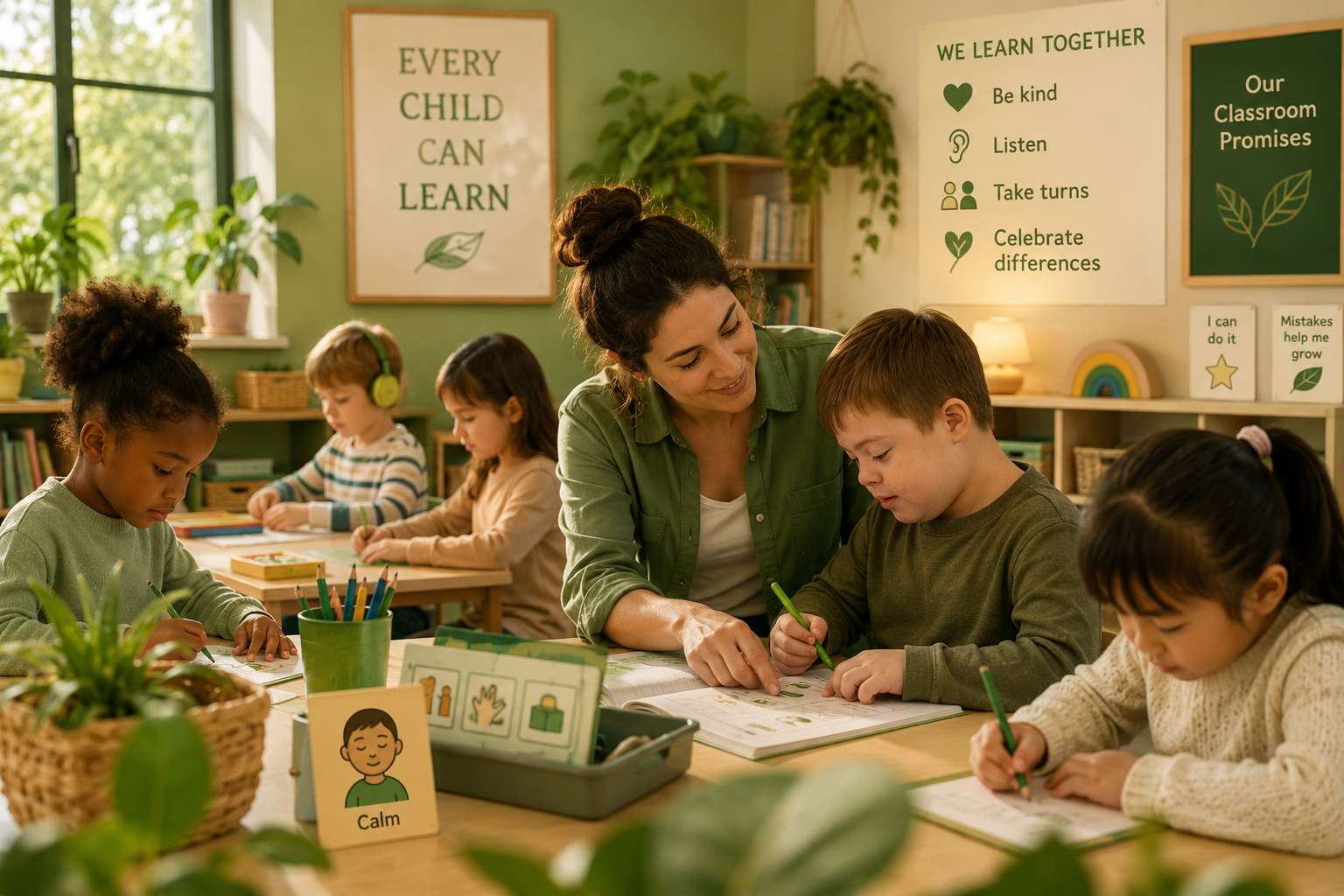
Inclusive elementary classroom cover image

Vocabulary

Click a card to flip it. Use Speak and Translate before discussing the example sentence.

Reading Article

Read the article. Hover over highlighted vocabulary for a quick definition.

Modern Elementary Classrooms: Different Ways to Learn

Elementary classrooms have changed in many ways. In the past, many lessons looked the same for every child. Today, many schools try to create a more inclusivewelcoming different needs and abilities classroom, where children can learn in different ways. Some children understand best when they listen. Others need pictures, movement, repetition, quiet time, or extra supporthelp that makes learning easier or safer.

Clear routinesregular ways of doing things can make the school day feel calmer. A morning greeting, a simple visual schedule, and short instructionsinformation that tells someone what to do help children understand what will happen next. When the classroom feels predictable, some children find it easier to focusgive attention to one thing and participate.

Many classrooms use a visual aida picture, card, chart, or object that helps understanding, such as picture cards, colour-coded steps, or simple diagrams. These tools can help children with a learning difficultya challenge with reading, attention, memory, language, or another learning area, but they can also help the whole class. A picture can sometimes explain an activitya task or exercise in class faster than a long spoken explanation.

The emotional feeling of a classroom is also important. Children often learn better when the room feels calmquiet, peaceful, and not stressful and welcoming. Positive words can build confidencethe feeling that you can do something, especially when a child is nervous or unsure. Some children become more independentable to do things with less help when adults notice small progressimprovement over time.

In recent years, many schools have introduced more flexible ways to support children. Some classrooms created quiet corners, movement breaks, and teamwork tasks. These changes do not make every lesson perfect, but they show an important idea: children do not all learn in the same way. An inclusive elementary classroom gives children more than one path to understand, communicate, and feel part of the group.

Discussion

These questions are for opinion, experience, and natural speaking. There are no “right” answers.

Example: I think children feel comfortable in a calm classroom with clear routines and kind communication.
Example: Yes, I think classrooms are more flexible today, and teachers use more visual aids and activities.
Example: Many children enjoy games, pictures, movement, songs, and activities where they can participate.
Example: Some children focus better when the room is calm and there is less noise or pressure.
Example: Children build confidence when adults encourage them and notice small progress.
Example: Yes. A simple morning routine can help children understand what will happen next.
Example: Technology and visual material can make instructions clearer and help children understand ideas faster.
Example: A positive classroom feels safe, friendly, organised, and patient.

Language Focus from the Article

Look at sentences from the article. Choose the tense, then check the reason why that tense is used.

1. “Clear routines can make the school day feel calmer.” What tense/structure is used?

Reason: This talks about a general possibility or general truth. “Can” shows what routines are able to do.

2. “Children often learn better when the room feels calm.” Why is Present Simple used?

Reason: Present Simple is used because the sentence describes something generally true about children and learning.

3. “Many schools have introduced more flexible ways to support children.” What tense is used?

Reason: Present Perfect shows a change that started in the past and is still important or visible now.

4. Why is Present Perfect used in “have introduced”?

Reason: “Have introduced” tells us that schools made changes before now, and those changes matter in classrooms today.

5. “Some classrooms created quiet corners.” What tense is used?

Reason: Past Simple describes a finished action in the past. The classrooms created the corners before now.

6. “These tools can help children.” Why is “can” used?

Reason: “Can” shows that visual tools are able to help; it does not say they always help every child in every situation.

Controlled Tense Practice

Complete or transform the sentences. Then check the reason for the tense.

need — Reason: Present Simple describes a general truth or usual situation.
created — Reason: Past Simple describes a finished action in the past.
have introduced — Reason: Present Perfect shows a change from the past that is still important now.
can make — Reason: “Can” shows possibility or ability.
Children learn in different ways. — Reason: With plural “children,” we use the base verb “learn.”
The school used picture cards. — Reason: Past Simple shows a finished past action or past situation.
Classrooms have changed a lot. — Reason: Present Perfect connects past change to the present situation.
Example: Children usually feel calmer when routines are clear. — Reason: “Usually” often goes with Present Simple because it describes habits or regular situations.

Speaking Practice

Simple opinion and experience practice. Use the vocabulary, but keep the answers relaxed and personal.

inclusivesupportroutineencourageconfidencecalmvisual aidprogressparticipatelearning difficulty
Example: In my opinion, a calm classroom has clear routines, simple instructions, and a friendly atmosphere.
Example: Children usually enjoy short activities, games, pictures, songs, and tasks where they can move or create something.
Example: Yes, I think routines help because children know what to expect and they can feel calmer.
Example: Children feel confident when adults encourage them, notice small progress, and give them time to answer.
Example: I prefer a balanced classroom. Sometimes children need quiet focus, but sometimes active learning helps them participate.
Example: From my experience, short instructions, examples, gestures, and visual aids can make instructions easier.

Easy Sentence Builder

Click a phrase, then finish the sentence in your own words.

Talk about routines.

Routines help children becauseA good routine usuallyIn my classroom experience,

Talk about confidence.

Children feel confident whenEncouragement is important becauseSmall progress can

Vocabulary Check

Choose the best answer. Correct answers are mixed.

Homework

Review the classroom vocabulary with relaxed writing, tense awareness, and prepositions.

Part 1: Finish the Sentence · 8 points

Finish each sentence with your own idea. Use the vocabulary from the lesson when you can.

Model answer: In my opinion, a positive classroom should feel calm, safe, and welcoming.
Model answer: Some children learn better when the teacher uses pictures, examples, and clear routines.
Model answer: I think visual aids are useful because they help children understand instructions more easily.
Model answer: A calm classroom can help students focus and feel more confident.
Model answer: From my experience, children participate more when they feel encouraged and supported.
Model answer: Routines are important because they help children know what will happen next.
Model answer: A teacher can support a nervous child by speaking calmly and giving the child more time.
Model answer: One thing that builds confidence is noticing small progress and saying something encouraging.

Part 2: Tenses Review & Practice

Choose the best tense. Then check the reason in the answer.

1. Teachers usually ___ routines to help children feel calm.

Answer: use. Reason: Present Simple describes routines and general facts.

2. Last year, the school ___ a quiet reading corner.

Answer: created. Reason: Past Simple describes a finished action at a finished time: last year.

3. Many classrooms ___ more visual aids in recent years.

Answer: have used. Reason: Present Perfect connects past changes with the present. “In recent years” shows the period continues until now.

4. When I was a child, my classroom ___ very different.

Answer: was. Reason: Past Simple describes a situation in a finished past time: when I was a child.

5. Some children ___ extra time to finish activities.

Answer: need. Reason: Present Simple describes something generally true.

6. This week, I ___ that clear instructions help students focus.

Answer: have noticed. Reason: Present Perfect can describe a recent experience connected to now. “This week” is still continuing.

7. Yesterday, the children ___ a teamwork activity.

Answer: did. Reason: Past Simple describes a finished action at a finished time: yesterday.

8. Schools ___ a lot since I was young.

Answer: have changed. Reason: Present Perfect describes change from the past until now.

Part 3: Prepositions Practice

Choose the correct preposition for each classroom sentence.

1. Children often feel safer ___ a clear routine.

Answer: with. We say “feel safer with a routine.”

2. Some students need support ___ reading and writing.

Answer: with. We say “need support with” a skill or activity.

3. A visual aid can help children focus ___ the task.

Answer: on. We say “focus on” something.

4. Teachers communicate ___ parents about progress.

Answer: with. We say “communicate with” a person.

5. Students participate ___ classroom activities.

Answer: in. We say “participate in” an activity.

6. A calm voice is helpful ___ a nervous child.

Answer: for. We say something is “helpful for” someone.

7. Small progress can build confidence ___ children.

Answer: in. We often say “build confidence in children.”

8. Teamwork ___ adults can support students.

Answer: between. We use “between” for cooperation involving people or groups.